crest.jpg

Service Times

SUNDAY SERVICES:
Morning Services
  • 9:30 am
Evening Services
  • 6:30 pm [1st Sunday September - 1st Sunday June]
  • 5:30 pm [2nd Sunday June - Last Sunday August]
SUNDAY SCHOOL:
  • 9:30 am

Our Church - A Brief History
St. Paul’s Presbyterian Church, Spring Hill, was dedicated to worship on 5th May 1889, the same year that witnessed the completion of the Eiffel Tower in Paris.

Church

The Church is of special significance to the architectural heritage of Brisbane as it is one of the buildings of the Colonial Architect, F.D.G. Stanley. Stanley was also responsible for the General Post Office, the Queensland Club, the National Bank building in Queen Street (formerly the Queensland National Bank), and the Port Offices.
Unexpected boom times in Queensland led to the construction of the new Church at the Spring Hill site. The congregation, members of the United Presbyterian Church of Scotland, had previously worshipped in a wooden Church in Creek Street and had built a handsome stone Church on the Creek Street site only thirteen years earlier, in 1876.

The Creek Street Presbyterian Church congregation was persuaded to sell its land in 1885 to the Queensland National Bank for the sum of ₤18,750. As a result the congregation acquired the Spring Hill property, which had been the site of the first Children’s Hospital, for the relocation of the Church.

Much of the stonework from the demolished Creek Street Church was used in the new building. So were the iron railings and gates. The foundation stone at Spring Hill was laid on 8 October 1887 and the building was dedicated to worship nineteen months later (May 1889). The brick Sabbath School building (as it was then known) had been built by 1886, and was used for worship during the construction of the church.

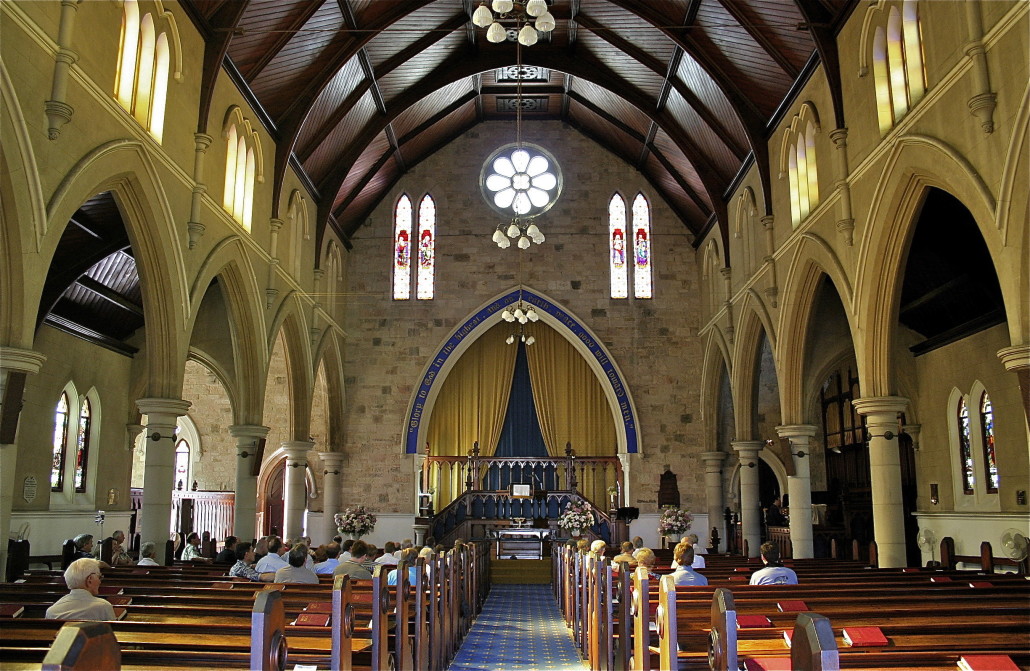
brisbanestpaulspres2.jpgThe Church interior is comprised of a nave supported by solid stone-capped pillars and Gothic arches facilitating an interior space characterised by a height greater than the width. Beyond the main support arches stand the aisles, which contribute significantly to the sense of spaciousness within the church. The windows of the aisles are all of stained glass.
The ceiling, of wooden arches and diagonal tongue and groove v-jointed boarding and fretwork vents, is executed in red cedar and is an excellent display of wood craftsmanship. The framing structure of the ceiling consists of collar-braced trusses.
A sloping floor, in pine, with a 45 cm fall from rear to front, adds to the dignity of the interior and focuses attention to pulpit and communion table.

The pulpit and communion table areas, and the choir stalls, are all beautifully defined in red cedar woodwork. All the pews are also made from red cedar.

A major feature of the interior of the Church is the set of ten pairs of stained glass windows depicting scenes from the life of St Paul, set in the windows of the aisles.
In the 1890s St Paul’s, with its lofty steeple, dominated the Brisbane skyline and was widely known as “the Kirk on the hill”.
The basic Church structure was executed in porphyry stone, and has remained sound. The facings and ornamentations are in sandstone, and have suffered significantly from erosion. A restoration appeal has been operative for several years.

Pipe Organ

An additional fbrisbanestpaulspres4.jpgeature of St. Paul's Church is the 1882 Hill & Son, London, (Job No 1834) pipe organ. It has 20 ranks of pipes with 2 manuals. The organ was originally brought to Brisbane for the earlier Church in Creek Street (established 1863) and was then moved to the newly built present St. Paul's Church in St. Paul's Terrace. The new Church was opened for worship in 1889.
The organ was rebuilt in 1963 by Whitehouse Bros. and altered from tracker action to electro-pneumatic action with extended console. The keyboards and pedal board were extended from 56/30 to 61/32. All of the original pipe work was retained and 146 new pipes were added in the rebuild.
Some restoration work was carried out by Bert Jarrott in 2008 including a new "Ventus" motor and blower from Germany, plus the refurbishing of two sets of bellows and some other structural work.
Last Updated ( Sunday, 12 July 2009 )